Drywood termite localized timber micro-treatment delivers direct-injection chemistries precisely into active feeding tunnels inside structural framing rather than relying on perimeter ground barriers. Unlike native…
Drywood termite localized timber micro-treatment delivers direct-injection chemistries precisely into active feeding tunnels inside structural framing rather than relying on perimeter ground barriers. Unlike native subterranean species that return daily to coastal soil, drywood termites (Cryptotermes brevis and Incisitermes snyderi) spend their entire life cycle embedded within seasoned structural wood, as documented by the University of Florida Entomology Department. Homeowners in the Downtown Historic District and South of Broad frequently discover distinctive, six-sided fecal pellets (frass) tumbling from tongue-and-groove heart-pine ceilings or lath-and-plaster wall cavities. When galleries remain confined to individual historic beams, window sashes, or roof rafters, localized micro-injection halts timber degradation instantly without displacing residents or enveloping historic architecture in heavy vinyl tarps.
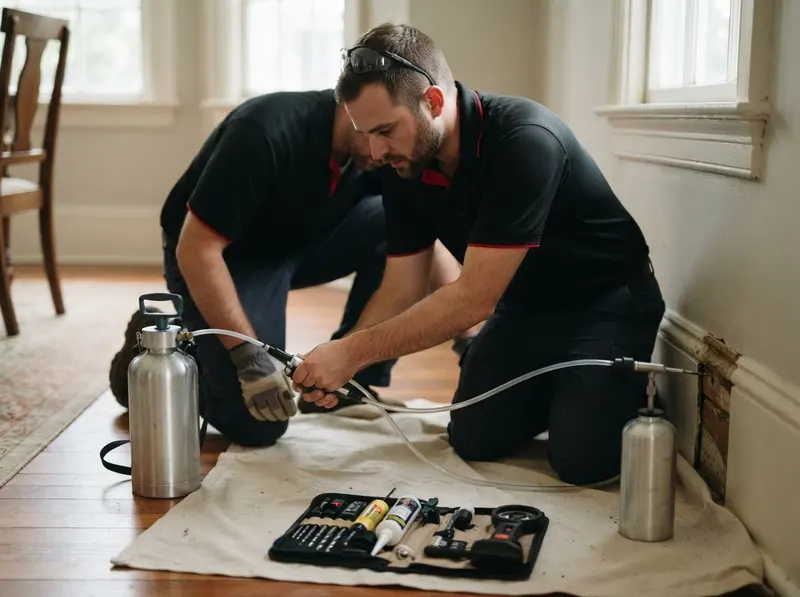
The technical procedure relies on locating active galleries using optical borescopes and precision acoustic listening instruments, followed by 1/8-inch access channels placed along the grain of the infested lumber. Technicians inject targeted, non-repellent formulations, such as localized liquid termiticides registered under EPA pesticide regulations or pressurized disodium octaborate tetrahydrate, directly into the heart of the nest. The Clemson University Department of Pesticide Regulation establishes strict standards for structural pesticide applications in South Carolina, which EmberRoot Bug Removal executes with clinical precision to avoid off-target chemical drift. The internal hydraulic pressure carries the active ingredient throughout the feeding network, eradicating workers, soldiers, and the reproductive queen while leaving surrounding living quarters scent-free.
This surgical protocol excels for isolated infestations inside architectural wood, timber trusses, and historic subfloors across Harleston Village, Wagener Terrace, and Radcliffeborough. However, clear physical limitations dictate application suitability: if diagnostic acoustic mapping reveals widespread infestations penetrating multiple load-bearing walls across separate floors, or if colonies invade inaccessible roof dead-spaces, localized micro-treatment cannot replace total structural remediation. Properties bordering maritime salt marshes on James Island, Johns Island, and Daniel Island experience intense summertime swarming humidity, requiring continuous moisture control per HUD structural moisture guidelines and annual acoustic re-verification. Structural repairs for damaged framing must comply with the International Building Code and South Carolina Building Standards to preserve load capacities following pest clearance.
Execution follows an exact three-step sequence: First, high-frequency sonic sensors locate timber voids along wall plates and joists. Second, technicians drill surgical micro-ports and apply deep-gallery non-repellent agents at 20 to 30 PSI, dispersing lethal doses directly into termite runways. Third, all injection ports are plugged with high-density wooden dowels and sealed with paint-grade wood compound. Field operations adhere to worker exposure limits under OSHA respiratory safety standards, while all timber preservation benchmarks match guidance from the USDA Forest Products Laboratory and the American Wood Protection Association.
Every job gets a firm, written price after a free on-site visit.
Tell us about your drywood termite localized timber micro-treatment job in Charleston and we'll send a clear, written quote, usually the same day.
 EmberRoot Bug Removal