Subterranean termite soil treatment creates an unbroken chemical barrier along continuous exterior foundation walls, interior stem walls, and crawlspace support piers. Lowcountry native subterranean species and…
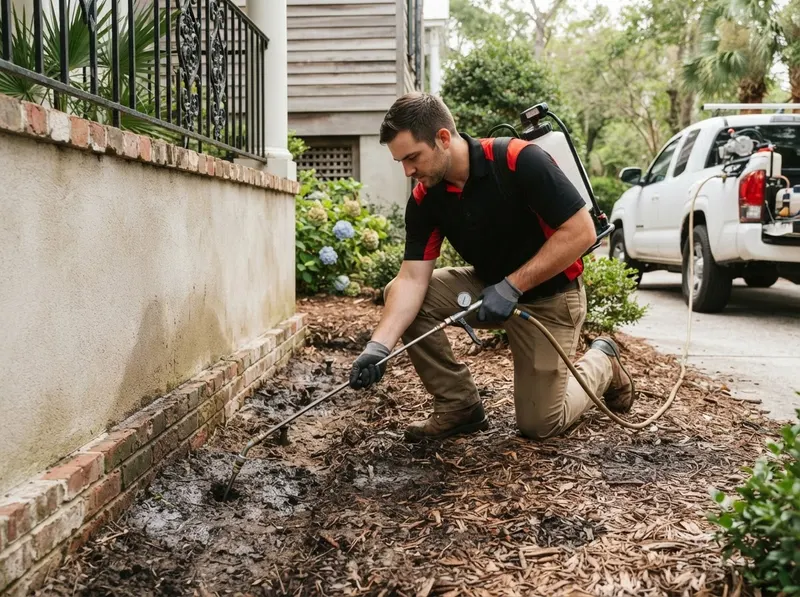
Subterranean termite soil treatment creates an unbroken chemical barrier along continuous exterior foundation walls, interior stem walls, and crawlspace support piers. Lowcountry native subterranean species and invasive Formosan subterranean termites nest below the frost line in saturated coastal soils, traveling vertically through structural timbers via mud exploration tubes. Applying liquid non-repellent termiticides, such as fipronil or imidacloprid, directly into 6-inch by 6-inch perimeter soil trenches allows foraging termites to pass through the treated zone undetected. The slow-acting active ingredient adheres to the insect cuticle, facilitating mechanical transfer throughout the subterranean colony via mutual grooming and trophallaxis before lethal toxicity takes hold, aligning with guidelines from the Clemson University Department of Pesticide Regulation and the Environmental Protection Agency.
Soil composition and structural engineering across Charleston County dictate specific mechanical delivery methods. Historic masonry buildings in the Downtown Historic District, South of Broad, Harleston Village, and Radcliffeborough frequently rest on historic brick piers over shallow, high-water-table soil. These foundations demand careful low-pressure rodding to saturate soil zones without destabilizing historic lime mortar or disturbing subgrade brickwork. In slab-on-grade or modified crawlspace homes in West Ashley, James Island, Johns Island, and Daniel Island, structural expansion joints, plumbing penetrations, and exterior patios require precision vertical drilling through concrete every 10 to 12 inches to place termiticide under the slab, in accordance with standards established by the National Pest Management Association and structural crawlspace preservation metrics detailed by the U.S. Department of Housing and Urban Development.
Liquid soil barrier treatments differ significantly from slow-acting cellulose bait stations. In high-density infestation corridors near tidal marshes, moisture-rich conditions allow subterranean colonies to bypass perimeter bait stations completely. A continuous liquid chemical barrier establishes immediate spatial defense around critical load-bearing timbers. The operational trade-off requires intrusive physical disruption: excavating soil trenches around perimeter vegetation, mechanical drilling through decorative porches or driveways, and crawlspace access maneuvers. Liquid applications follow label rates codified under the South Carolina Department of Agriculture to protect surrounding brackish groundwater, while adhering to regional soil conservation principles from the Natural Resources Conservation Service and moisture-remediation benchmarks set by the Centers for Disease Control and Prevention. EmberRoot Bug Removal executes these targeted subterranean treatments without surface broadcast spraying.
Every job gets a firm, written price after a free on-site visit.
Tell us about your subterranean termite soil treatment job in Charleston and we'll send a clear, written quote, usually the same day.
 EmberRoot Bug Removal