Subterranean termites require continuous soil moisture and exploit hairline settlement fissures in concrete foundations to breach homes. Standard exterior trenching fails when structural slabs, tiled verandas, or…
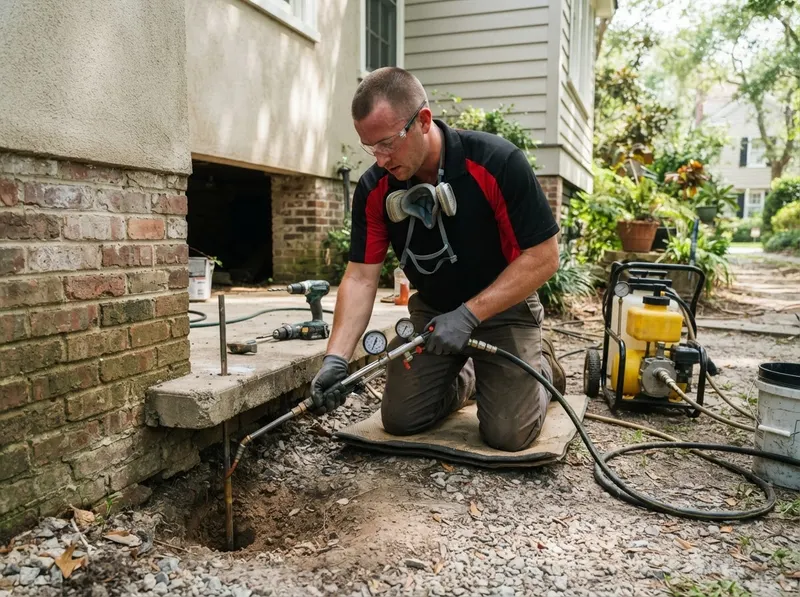
Subterranean termites require continuous soil moisture and exploit hairline settlement fissures in concrete foundations to breach homes. Standard exterior trenching fails when structural slabs, tiled verandas, or enclosed utility rooms block direct soil contact. Sub-slab termiticide hydraulic injection resolves this architectural blind spot. Precision rotary hammer drills cut 0.5-inch ports through concrete slabs spaced roughly 12 inches apart along the interior perimeter footings. High-pressure injection wands force a uniform chemical barrier into the aggregate substrate beneath the masonry, soaking the sub-grade fill where colonies navigate. The treatment adheres to structural containment guidelines defined by the Environmental Protection Agency and specifications from the Clemson University Department of Pesticide Regulation, which oversees structural pest management rules across South Carolina.
In the Downtown Historic District and South of Broad, historic brick dependencies and masonry ground floors frequently rest over damp packed earth with no vapor barriers. Structures near The Battery and White Point Garden face severe pressure from subterranean termite super-colonies thriving in shallow, coastal water tables. According to soil mechanics standards from the Natural Resources Conservation Service, Charleston County coastal soils alternate between dense clay and porous sandy loam, causing conventional topical termiticide drenches to wash away or disperse unevenly. In neighborhoods like Wagener Terrace, Harleston Village, and Radcliffeborough, post-construction additions, such as enclosed porches converted to slab-on-grade kitchens, create hidden pathways. Sub-slab hydraulic injection targets these blind access points, penetrating compacted fill beneath monolithic slabs where retail surface applications and legacy perimeter sprays cannot reach.
Slab injection serves distinct architectural scenarios compared to conventional perimeter trenching or crawlspace dusting. If a structure rests entirely on open brick piers, crawlspace ground clearing and soil trenching provide the primary barrier. If the foundation incorporates monolithic floating slabs, garage transitions, or filled porches, common in West Ashley, James Island, and newer developments on Daniel Island and Johns Island, sub-slab injection is necessary to seal structural voids. Concrete drilling introduces brief rotary mechanical noise and minor aggregate dust, which technicians control using HEPA vacuum extraction units built to Occupational Safety and Health Administration air quality standards. Once chemical volumes meet structural benchmarks outlined by the National Pest Management Association, ports are sealed flush with high-compressive-strength hydraulic cement matching the existing floor profile.
Environmental variables dictate hydraulic volume. The chemical solutions utilize non-repellent active ingredients classified by the National Institute for Occupational Safety and Health as low-odor, non-volatile compounds that bind securely to soil particles without evaporating into household living spaces. Field guidance from the Association of American Pesticide Control Officials dictates exact flow rates to prevent subterranean backflow into municipal utilities, adhering to cross-contamination protocols established by the American Water Works Association. Foundation movement verified against civil parameters from the American Society of Civil Engineers indicates that unchecked subterranean colonization can undermine slab sub-grades over 3 to 5 years. EmberRoot Bug Removal operates on-site evaluations across Charleston to calculate precise linear drill grids, confirm footing depths, and establish exact chemical application volumes. Structural assessments can be coordinated by calling (843) 268-6996.
Every job gets a firm, written price after a free on-site visit.
Tell us about your sub-slab termiticide hydraulic injection job in Charleston and we'll send a clear, written quote, usually the same day.
 EmberRoot Bug Removal